- May 2, 2024
Using Classical Conditioning to Build Fantastically Confident Behaviors in Agility
- Rebecca Jernigan
- Training Fundamentals
In training for the sport of agility, dogs not only need to understand how to do the obstacles, but have the confidence and desire to do them with speed. They need to be sure-footed as they run at top speeds across the narrow plank of the dog walk. They can't hesitate as they turn and race towards the steep assent of an A-frame. So how do we go beyond teaching our dogs how to do the skill to create the dog who wants to race through the course? We have to remember that Pavlov is on our shoulder!
Classical Conditioning
Ivan Pavlov described classical conditioning, a form of associative learning, in the late 1800s. You may also hear classical conditioning described as "stimulus-response" learning as it describes the process in which we can create a conditioned response to a stimuli. In the classic example of Pavlov's dog (does it ring a bell?)
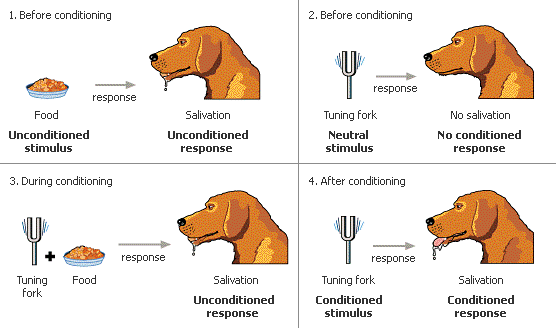
In classical conditioning, an unconditioned stimulus (UCS) naturally triggers an unconditioned response (UCR). In part 1, the food (UCS) automatically causes the response of salivation in the dog (UCR). We also know that the sound of a tuning fork (neutral stimulus, NS) has no response to it. Through repetition of playing the sound of the tuning fork and then presenting the food (part 3), we are going to create a conditioned response. Now when the tuning fork is sounded, the dog salivates in anticipation of the food. As such, the tuning fork becomes the conditioned stimulus and the salivation becomes the conditioned response. This is one of the most powerful ways that animals learn and we can employ it extensively in our agility training.
Classical Conditioning in Agility/Training
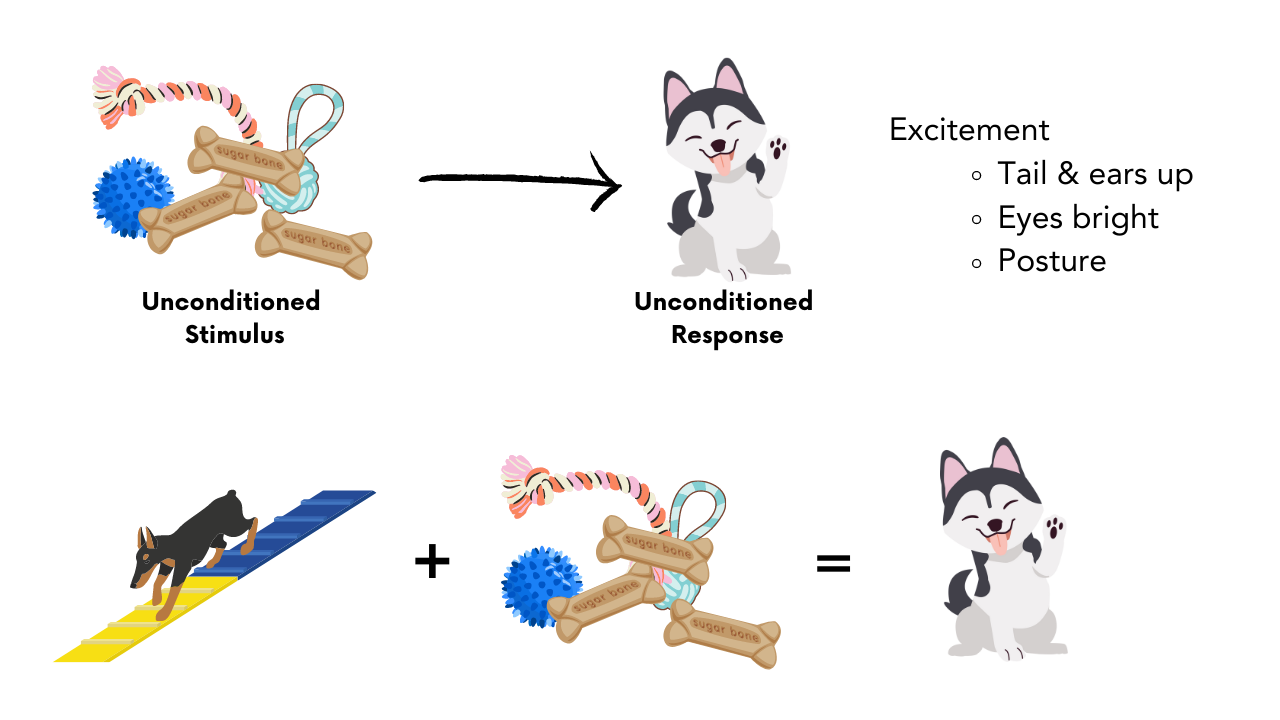
This is where the phrase "Pavlov is always on your shoulder" comes up, because no matter what you are doing or training, there are elements of classical conditioning sprinkled throughout. One of the biggest ways that our dogs experience classical conditioning is through our rewards in agility. Recall that our reinforcers are defined by the subject --our dogs. It has to be something that they want. But also, these can act as an unconditioned stimulus with an unconditioned response. What happens when our dog's favorite toy, treat, or anything comes out? We might use a word to describe their emotional state, like happy, excited, or joyful, but realistically, we are using emotion words to describe physical responses. What does your dog do that makes them "look" happy or excited? Is it the way they wag their tail? Do their eyes light up? Maybe they are more active, have an alert posture, or even do a little bum wiggle! These are unconditioned responses to a stimuli -- YOUR food/treats/toys/etc. It can be anything! Now think about when we go to agility practice. We grab our gear, get in the car, and then show up to this new place and what happens next? If you said that we get lots of those amazing treats and toys, you'd be right! So overtime, we pair these procurers, this neutral stimuli, to all of these amazing things! And then with repetition, we create a conditioned response which is evident when our dogs are showing all of the signs of excitement and joy for coming to agility class.
Now -- also remember this works both ways. Poor experiences can also turn neutral stimuli into something that evokes behaviors associated with fear and anxiety. Just as our dogs can learn that getting in the car means exciting agility practice, other dogs may have learned that getting in the car is always followed by the feeling of car sickness or if they had an uncomfy vet visit. Then the neutral stimulus of the car becomes paired with what came to follow = bad news bears! So we always want to be mindful of the experiences we are creating for our dogs as they shape their behavior.
Creating Agility Confidence from Day 1
Learning new things is hard! That goes for dogs too. So when I'm starting a new behavior, I first off want a reward that my dog LOVES. It might be hard, but I want to make it worth their while. And then, when they play my silly little game -- maybe it's stepping on a box or walking over plastic (nothing innately exciting) -- they get rewards for this!! This works two fold: first, we start going down the path of operant conditioning, where you can earn rewards for a behavior; and second, I'm creating an association between myself (the trainer), the equipment, and the excitement of these magnificent rewards. When I reward my dog for small, seemingly insignificant efforts at the beginning I'm teaching them two specific skills: how to try (offer behavior) and that this is a good game to be playing.
****
When I am rewarding these little micro-progressions, as a result, I'm going to get a dog who does more of what I rewarded, which is offering the behavior) [operant conditioning] and is excited to play my game more [classical conditioning].
****
Once I have this -- a dog who wants to play and is offering behavior, then we can start getting into molding that behavior into what we want!