- Apr 30, 2025
Schedules of Reinforcement: How Often Should You Reinforce Your Dog?
- Rebecca Jernigan
- Training Fundamentals
As dog trainers or behavior enthusiasts, you're likely familiar with the phrase "behavior that is reinforced is more likely to occur again." This principle, rooted in B.F. Skinner’s operant conditioning framework, is foundational to modern reinforcement-based dog training. But there's a layer of nuance that often goes unexplored, especially by new trainers: how often should you reinforce a behavior?
That’s where schedules of reinforcement come into play. Reinforcement isn’t just about what you give (toys, treats, praise, permission, etc.) – it’s also about when. And when you deliver your reinforcement can make all the difference in how consistent, reliable, and accurate a behavior becomes.
Let’s dive into the psychology behind reinforcement schedules, the four primary types, and how these concepts can be applied directly and effectively to your dog training practice.
What are Schedules of Reinforcement?
Schedules of reinforcement refer to how a behavior is followed by a reinforcer over time. In training terms: how frequently do you reward your dog for a given behavior?
There are two broad categories:
Continuous reinforcement: Every correct response is reinforced.
Partial (also called “intermittent”) reinforcement: Only some responses are reinforced.
Let’s make a hypothetical training session: teaching your dog to step on a 2’ x 2’ yoga mat. Your criteria for a correct response is the act of the dog stepping on the yoga mat with any paw. If you wanted to use continuous reinforcement, you would reward every single time the dog steps on the mat – the correct criteria. This is powerful for starting new behaviors because it will give you a high rate of reinforcement (the number of times you give a reinforcer per unit of time) which is beneficial for encouraging a high rate of response (number of times any behavior is offered per unit of time). Later on, this can be useful for shaping a behavior when you want to narrow your criteria to a more specific behavior, such as only placing the front two feet on the mat. Once the behavior is learned, partial reinforcement schedules are introduced to maintain the behavior over time, create consistency, confidence, and build resilience against distractions.
Why are both categories important?
Continuous reinforcement has the most apparent rationale and the most common analogy used in dog training is “your reinforcement is your dog’s paycheck.” This looks at dog training from the perspective of imagining going to work, doing a job, and getting paid. Getting paid is important, and begs the question: would you do your job if you weren’t paid? Without devolving into to much analogy, metaphor, and philosophy, my personal takeaway is for behaviors that are often repetitive and potentially dull/not exciting, continuous reinforcement is valuable for keeping the reinforcement high.
So why would we ever use intermittent rewards? For one, they make the behaviors more resilient to extinction. The classic example of this is gambling on a slot machine. Why do people keep putting money in the machine and pulling the level (aka. The desired behavior) when they don’t when? The answer lies within intermittent reinforcement schedules. Without diving into the neuroscience and dopamine signaling, there is partial reward in the form of anticipation, thinking you are going to win, and then every once in while (possibly rare while) there is a reward. That reward could vary in size, such as small prizes that keep people playing in hopes of winning “the big one” or even tricky patterns in classical condition to flash lights and play sounds making you think you’ve won! What is the outcome? Unfortunately for this example, the behavior can become addictive.
Want another example of how intermittent reinforcement schedules can be addictive? Think about how many ads you are okay with seeing next time you are scrolling on social media. How many ads do you view before you are rewarded with content you enjoy? All of this is behavior and reward schedules.
On that slightly dark note, why think about this for dog training? We want to build joy and fun into our dog training. We want our dogs to LOVE it, not just “yeah whatever” like it. In moderation, a little gambling and social media can be fun. I certainly scroll social media for entertainment. If everything were easy, why do it? Challenge and progress can also be part of the enjoyment. Partial schedules can help build that “game ON” factor where if you don’t get it at first, persist! And try harder next time!
And this is why using intermittent reinforcement skills is an extremely powerful strategy in behavior that can be employed in training sessions to strengthen skills, increase their resilience, and especially for preparing behaviors to be proofed with distractions.
Types of Partial Reinforcement Schedules
There are four main types of partial reinforcement schedules. Different schedules will be more or less useful in different circumstances, so like much in animal training, these are principles not protocols. These schedules can be based on responses or time until reinforcement.
Fixed Ratio (FR): Reinforce After a Set Number of Responses.
Example: Every 3rd time the dog steps on the mat, you reward
This can be helpful for behaviors where you want a high rate of response and it’s easy to learn the pattern. But it can also become repetitive and boring as a result.
Variable Ratio (VR): Reinforce After an Unpredictable Number of Responses.
Example: The dog receives a reward on the 1st, 3rd, and 2nd time they step on the mat. On average, they received a reward for every 2 repetitions. This is called a “VR - 2” schedule.
VR schedules are one of the most commonly used partial schedules in dog training since we are often basing training off of responses and this schedule is good for maintaining high rates of reinforcement and creating behaviors resistant to extinction.
A Word of Caution: This is a powerful method that can be a double-edge sword, so use it well and you can create a behavior that is incredibly resistant to extinction. Use it … well, poorly, and you might find yourself spending a while digging out of a difficult training challenge you created by mistake. An example? Say you are teaching your dog to weave 12 poles, and they are FAST and AMAZING at it. But then on one repetition, oops! They pop out at weave pole 10, but they are so fast that you were mid-throw and accidentally reward them anyways. And say they try popping out twice more, but you’re onto them, so no reward. They go back to doing it right…. Until psych! They get you again with a speedy 10-pole pop and are rewarded anyways. This is an example of how a variable ratio schedule has now been accidentally introduced to reinforce an unwanted behavior. And because this schedule helps make behaviors difficult to drive to extinction… trainers will have to be exceedingly careful about training this the longer (and more oops!-es) continue, and there’s a chance it might show up.
Fixed Interval (FI): Reinforce After a Set Amount of Time
Example: You ask your dog for a down (stay) and reward after 30 seconds, every time.
This schedule is included for comprehensiveness of the post, but not something I commonly use. If I were rewarding based on time, I would prefer a variable interval instead.
Variable Interval (VI): Reinforce After an Unpredictable Amount of Time
Example: You ask your dog for a down (stay) and reward after 5 seconds, then 15 seconds, then 7 ect. With random seconds. Like VR schedules, know what your average is.
This can be good for calm, duration style behaviors that take a long time to perform. It’s also better-suited to well established behaviors. So if you don’t have a good down (stay) behavior already, this likely isn’t a good method to include in your training protocols just yet.
And for those who are so academically inclined, I highly recommend reading about it from the sole psychology perspective using the link below and following up with the data and studies that have been performed on the topic.
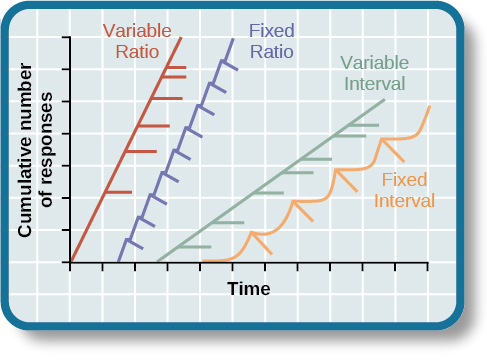
From the University of Central Florida: General Psychology Pressbook
Final Thoughts: Reinforcement Is a Strategy, Not a Shortcut
In going forward as dog trainers, I think that one of the things that elevates our training skills and our dogs performance is our ability to see the principles behind the protocols. Oftentimes we need to be adjusting our protocols to match the principles based on what we are seeing with our unique dog. Well written protocols often leverage principles in learning theory, like schedules of reinforcement, and can be extraordinarily useful. But the more we understand the principles themselves, the more successful we can be in training our dogs to help meet their needs. Employing and changing schedules of reinforcement are one of my favorite tools in helping my dogs take their behaviors to the next level by improving their resilience to difficulty and challenge, staying engaged and motivated for training, and creating long-lasting behaviors that I don’t need to go back and train later.
Happy training!